

BLESSED BE THE LORD MY STRENGTH
Psalm 144:1 “Blessed be the LORD my strength, which teacheth my hands to war, and my fingers to fight:”
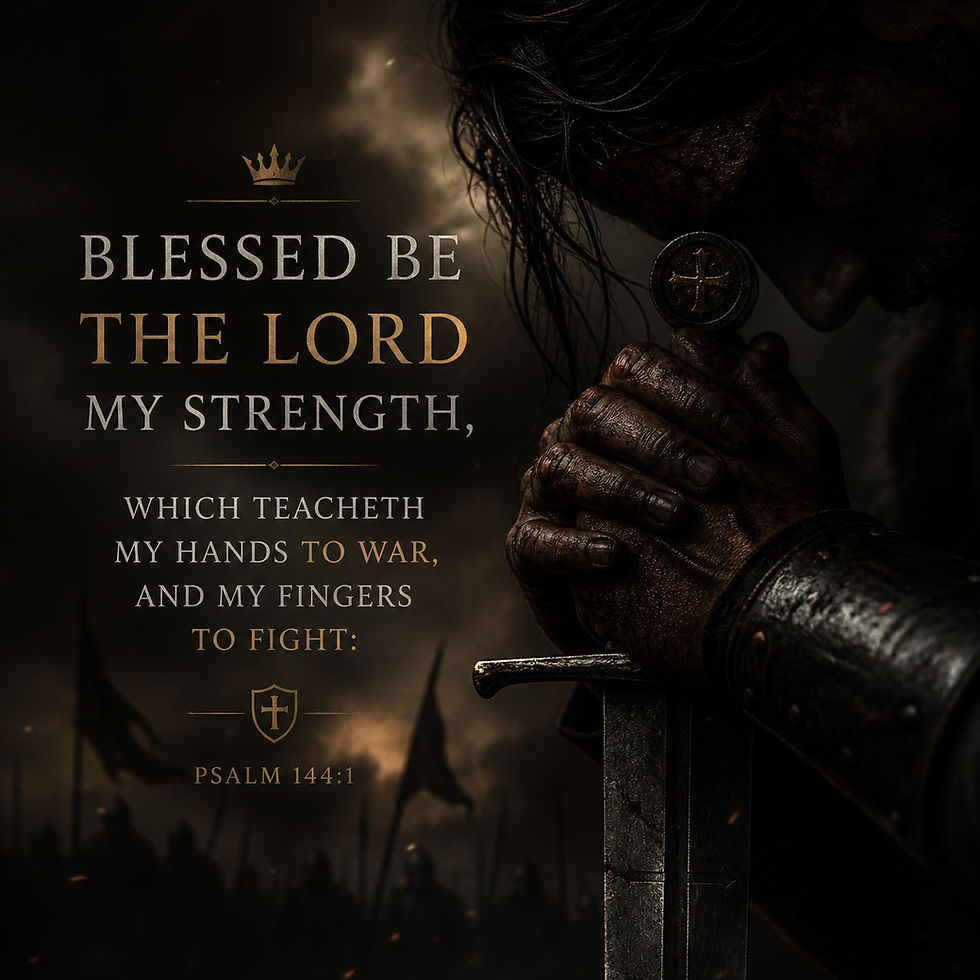
There is a dangerous lie circulating in modern culture—that manhood is passive, soft, and disengaged. Scripture presents the opposite. A man is not defined by aggression, but he is defined by readiness.
Readiness to stand.
Readiness to protect.
Readiness to act when others cannot (or will not).
David did not credit himself with strength. He said, “Blessed be the LORD my strength.” The source matters. This is not self-made masculinity. This is God-forged manhood. Strength that originates in a God produced discipline, restraint, and precision—not chaos.
The verse continues: “which teacheth my hands to war, and my fingers to fight.” That is training language. This is not instinct—it is instruction. God trains men. He develops them. He sharpens them. The problem is not that men are incapable; it is that many refuse training.
Every man is called to three arenas of responsibility: protection, provision, and preservation.
Protection is not optional. It is wired into the role. Protection is both physical and spiritual. A man who cannot or will not protect, leaves a vacuum—and vacuums get filled by chaos. Scripture consistently places men as watchmen, guardians, and defenders. In Nehemiah’s day, men built with one hand and held a weapon in the other (Nehemiah 4:17). Work and war existed together.
Protection begins spiritually. If a man cannot guard his own heart, he cannot guard a home. Proverbs 4:23: “Keep thy heart with all diligence; for out of it are the issues of life.” A compromised man produces a compromised environment. The first battlefield is internal—thoughts, discipline, convictions. Lose these grounds, and everything downstream collapses.
Then physical protection follows. This is not about living paranoid—it is about living prepared. A man should be capable. Capable of responding. Capable of enduring pressure. Capable of stepping forward when others freeze. Weakness disguised as comfort is still weakness.
Provision is the second arena. 1 Timothy 5:8 is direct: “But if any provide not for his own… he hath denied the faith, and is worse than an infidel.” Provision is not merely financial—it is comprehensive. Stability. Structure. Direction. A man sets the tone of the home. If he is erratic, the home will be unstable. If he is disciplined, the home gains structure.
Provision demands foresight. It demands sacrifice. It demands consistency when motivation disappears. This is where most fail—not in crisis, but in routine. Quiet neglect destroys more homes than dramatic collapse.
Modern statistics reinforce this reality. Homes without engaged, present fathers consistently show higher rates of poverty, behavioural issues, and instability. The absence of provision creates long-term damage that no system can fully repair. God designed the man to carry weight—not avoid it.
Preservation is the third arena. This is where strength meets wisdom. It is not enough to protect and provide; a man must preserve the spiritual health of his home. That means guarding doctrine, guarding influence, guarding direction.
Joshua 24:15 is not a suggestion—it is a declaration: “As for me and my house, we will serve the LORD.” That is leadership. That is decisive. A man sets the spiritual direction whether he realises it or not. Silence is still leadership—it just leads nowhere.
Preservation requires vigilance. The world does not remain neutral. It presses, it shapes, it influences. A passive man allows external forces to define his home, a trained man establishes boundaries.
David understood something critical—he was trained by God before he was tested by life. The battlefield reveals what training has produced. Pressure does not create character; it exposes it.
That is the issue with most men today. They wait for pressure to rise to the occasion. Scripture teaches the opposite. You do not rise—you fall to your level of your training.
If your habits are weak, your response will be weak.
If your discipline is inconsistent, your decisions will be inconsistent.
If your convictions are shallow, your leadership will collapse under strain.
God trains through routine obedience. Quiet disciplines. Repeated decisions. Scripture reading when no one is looking. Prayer when no one is listening. Physical stewardship when it would be easier to neglect. These are not small acts—they are training drills.
The phrase “teacheth my hands to war” implies repetition. Skill is developed through consistent practice. No soldier becomes effective by accident. No man becomes dependable without deliberate training.
This applies physically and spiritually.
Physically: a man should be capable. Strength, endurance, awareness. These are not vanity metrics—they are responsibility metrics. A man who cannot carry weight cannot protect those who depend on him.
Spiritually: a man must know the Word. Not casually—deeply. Ephesians 6:17 calls the Word of God the sword of the Spirit. If you are untrained with the sword, you are ineffective in battle.
Emotionally: control matters. Proverbs 16:32: “He that is slow to anger is better than the mighty.” Strength without control is liability. True strength is restrained power under command.
David’s testimony is not about war—it is about preparation. God trained him in private so he could stand in public. Before Goliath, there was a lion and a bear. Before the throne, there was obscurity.
Most want the visible victory without the hidden training, but that is not how God operates.
There is also a necessary mindset shift. Protection, provision, and preservation require willingness to do what is necessary—not what is comfortable.
Comfort is the enemy of readiness.
Ease erodes discipline.
Convenience weakens conviction.
A man must be willing to act when required—physically, spiritually, decisively. That does not mean reckless aggression. It means controlled readiness. The ability to step forward without hesitation when responsibility demands it.
Your family does not need perfection. They need reliability. They need a man who is steady, trained, and present. A man whose default response under pressure is strength—not panic.
Psalm 127:1 states: “Except the LORD build the house, they labour in vain that build it: except the LORD keep the city, the watchman waketh but in vain.” This balances the responsibility. God is the source—but the man is the instrument. God strengthens, but the man must submit to the training.
The failure point is rarely capacity—it is refusal. Refusal to train. Refusal to discipline. Refusal to take responsibility.
Every man is being trained—either intentionally or by default. Neglect is still training. It just produces weakness.
David closes the thought with worship: “Blessed be the LORD.” Strength is not self-exaltation—it is God-dependence. A man trained by God does not boast in ability—he honours the source.
The outcome is clear:
A trained man protects without hesitation.
A disciplined man provides without excuse.
A grounded man preserves without compromise.
That is not cultural masculinity. That is biblical manhood.
And it is not optional.


Comments