

THE COLLAPSE OF CHARACTER - PART 12
TRUCEBREAKERS
When Promises No Longer Matter
“…without natural affection, trucebreakers…”2 Timothy 3:3
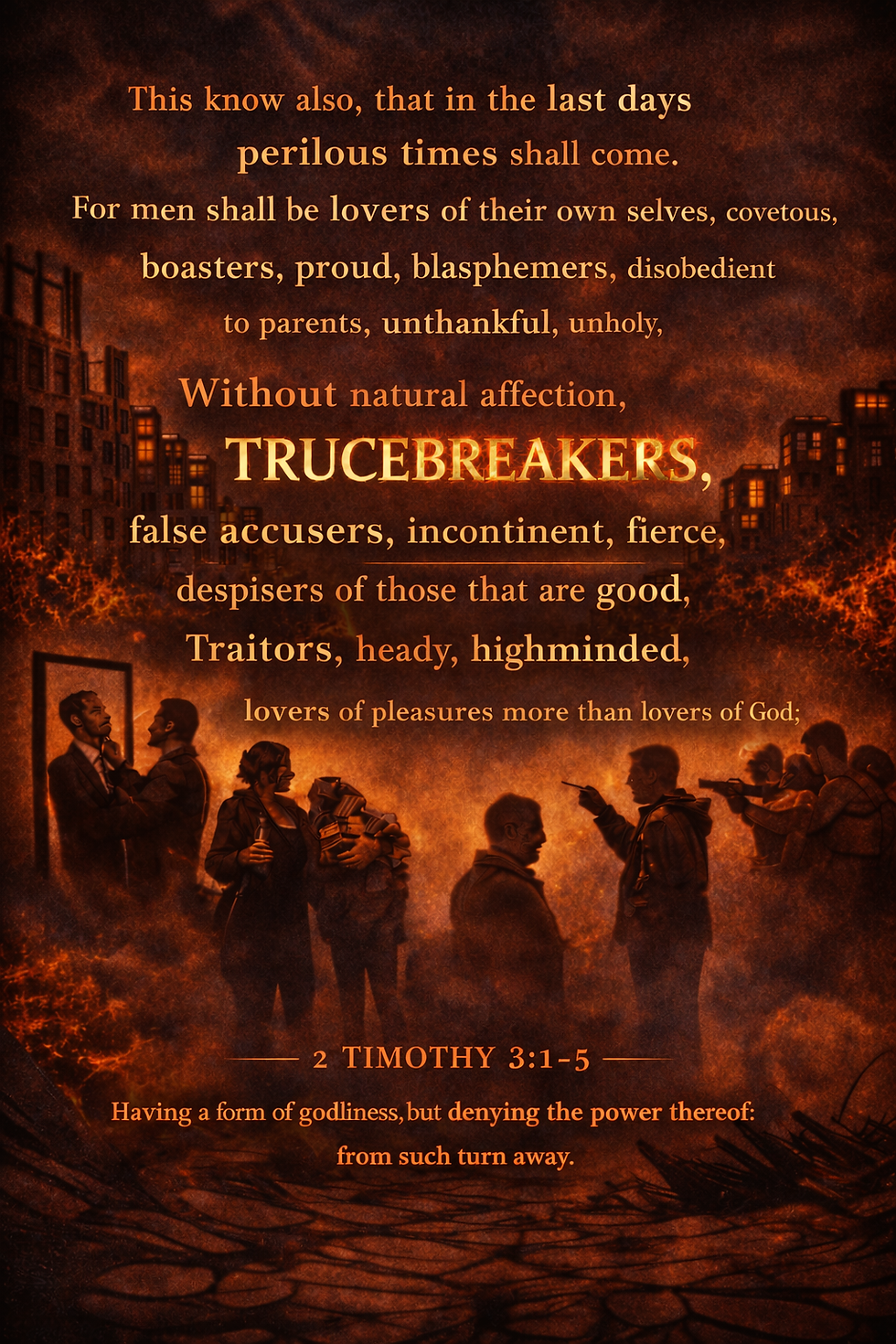
When natural affection collapses, faithfulness cannot long survive. Paul now exposes the next stage in the moral unraveling of the last days: “trucebreakers.” This word speaks not of emotional coldness, but of covenantal collapse. It describes people who make agreements lightly and abandon them easily.
A truce is a pledge of peace. To break it is to prove oneself unreliable, untrustworthy, and ungoverned by principle. Biblically, trucebreakers are those who cannot be bound by their word. Promises become provisional. Commitments are conditional. Loyalty lasts only as long as it is convenient.
Scripture places enormous weight on faithfulness. God Himself is described as the One who “keepeth covenant and mercy” (Deuteronomy 7:9). His faithfulness is the foundation of all trust. When humans abandon covenantal integrity, they reflect not freedom, but distance from God.
The psalmist described the righteous man as one who “sweareth to his own hurt, and changeth not” (Psalm 15:4). That phrase stands in stark contrast to the spirit of the last days. Faithfulness is proven not when promises are easy, but when they are costly. Trucebreakers reveal hearts that value comfort over character.
Paul warned the Romans of the same trait when he described a godless society as “covenantbreakers” (Romans 1:31). The repetition is significant. Covenant-breaking is not a peripheral sin; it is a hallmark of spiritual decay. When truth is negotiable, promises become disposable.
Charles Spurgeon warned that when men lose reverence for God, they soon lose respect for their own word. He observed that integrity erodes quietly, first excused as pragmatism, then defended as wisdom. But Scripture never calls unfaithfulness wisdom. It calls it sin.
History reinforces this truth. Winston Churchill warned repeatedly that agreements without honour are meaningless, and that peace built on broken promises is an illusion. Societies cannot function when trust is absent. Neither can churches. Neither can families.
Our own age displays this openly. Marriage vows are treated as temporary arrangements. Contracts are honoured only when enforced. Commitments are abandoned in the name of self-care. The phrase “I didn’t feel it anymore” has replaced “I gave my word.” Faithfulness is no longer admired; it is questioned.
This spirit presses deeply into spiritual life as well. Church membership is treated casually. Doctrinal commitments are revised to suit preference. Service is offered only when convenient. Even vows made before God are quietly reinterpreted. Ecclesiastes warns solemnly, “When thou vowest a vow unto God, defer not to pay it” (Ecclesiastes 5:4). God takes promises seriously—even when men do not.
Christ stands again as the contrast. Scripture declares that “having loved his own which were in the world, he loved them unto the end” (John 13:1). He did not abandon His mission when it became painful. He did not revise His commitment when it required sacrifice. Faithfulness carried Him to the cross.
For believers living in perilous times, trucebreaking must be resisted intentionally. Faithfulness must be reclaimed as a virtue. A Christian’s word should still mean something. Commitments should still carry weight. Loyalty should not be seasonal. Truth should not be adjustable.
Paul places trucebreakers immediately after without natural affection because when love becomes conditional, loyalty becomes impossible. When relationships are governed by feeling rather than covenant, promises become fragile.
The last days are marked by broken agreements and disposable commitments.But God’s people are called to be different.
Faithfulness has always been countercultural.And in perilous times, it becomes unmistakable.

Comments